木星がガニメデを食する
Jupiter Eclipsing Ganymede
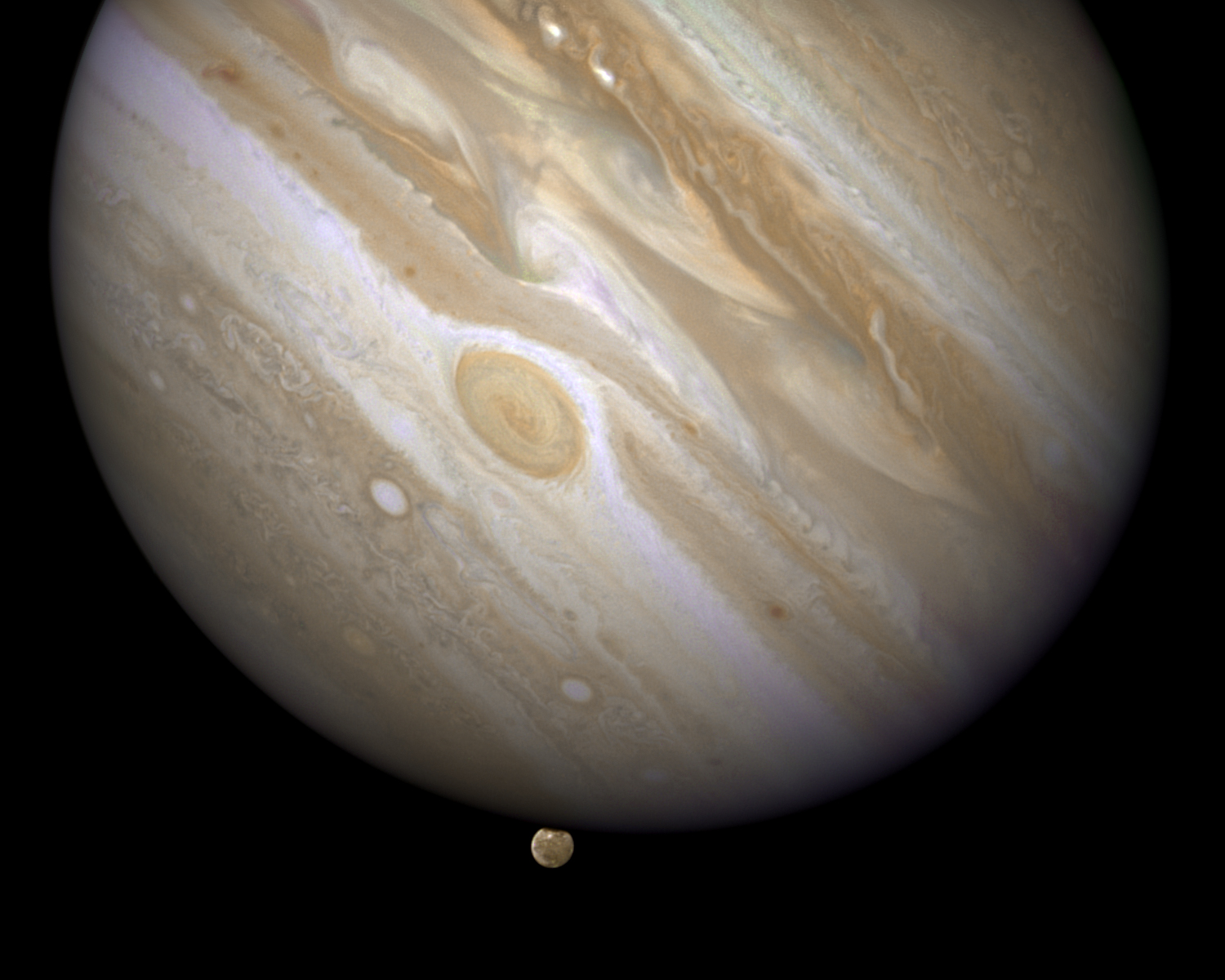
木星の上層大気はどれほど霞んでいるのでしょうか?それを調べるため、天文学者たちはハッブル宇宙望遠鏡を使って木星が衛星ガニメデを食する様子を観測しました。ガニメデは週に一度木星の周りを公転していますが、特に有用な掩蔽はもっと稀にしか起こりません。2007年4月には、このような掩蔽が鮮明な画像で捉えられました。木星の縁付近では、ガニメデが木星の上層大気を通して太陽光を反射するため、天文学者たちはさまざまな色でわずかな減光が見られることから、霞の有無を調べることができます。この調査の結果の一つが、上記の素晴らしい画像です。木星を囲む雲の帯や、大赤斑のような壮大な渦巻く嵐のシステムがはっきりと写っています。画像下部のガニメデも、暗い氷の表面に細かい模様がはっきりと見て取れます。木星とガニメデは非常に明るいため、地球上で小型望遠鏡を使えば、多くの食を観測することができます。
原文(English)
How hazy is Jupiter's upper atmosphere? To help find out, astronomers deployed the Hubble Space Telescope to watch Jupiter eclipse its moon Ganymede. Although Ganymede circles Jupiter once a week, a particularly useful occultation occurs more rarely. Such an occultation was captured in great visual detail in April 2007. When near Jupiter's limb, Ganymede reflects sunlight though Jupiter's upper atmosphere, allowing astronomers to search for haze by noting a slight dimming at different colors. One result of this investigation was the above spectacular image, where bands of clouds that circle Jupiter are clearly visible, as well as magnificent swirling storm systems such as the Great Red Spot. Ganymede, at the image bottom, also shows noticeable detail on its dark icy surface. Since Jupiter and Ganymede are so bright, many eclipses can be seen right here on Earth with a small telescope.
\ この感動を宇宙仲間にシェア /
宇宙をXでシェア
© NASA / APOD