マウナケア山頂の天の川
The Milky Way Over Mauna Kea
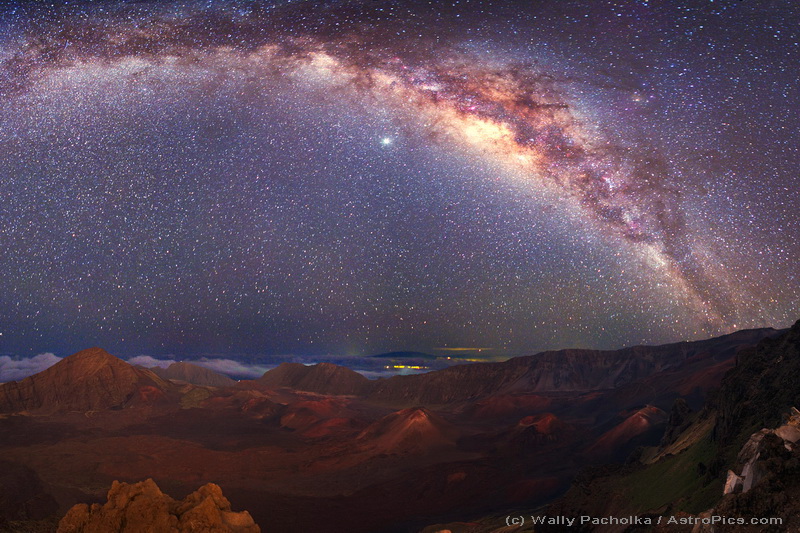
天の川銀河の帯を見たことがありますか? 晴れた空の下、暗い場所で適切な時間に見ると、空に淡い光の帯が現れます。目が暗順応するとすぐに、初めてその帯を見つけるかもしれません。そして、はっきりと見えるようになり、壮観になります。驚きが増す理由の一つは、このぼんやりとした帯に何十億もの星が含まれており、私たちの渦巻銀河の円盤であるという事実に気づくことでしょう。私たちはこの円盤の中にいるので、帯は地球を一周しているように見えます。上の画像では、夜空高くに天の川銀河の帯が弧を描いて見えます。帯のすぐ下にある明るい点は木星です。手前には、アメリカ合衆国ハワイ州マウイ島にあるハレアカラ火山の月光に照らされたカルデラがあります。地平線近くをよく見ると、薄い雲と、ハワイ島にある暗くて巨大なマウナケア火山が見えます。天の川を見たことがない方や、木星を認識したことがない方は、今年がそのチャンスかもしれません。2009年は国際天文学年なので、宇宙の奥深くを覗き込む窓を通して、あなたの身近な場所で天体観測ができる機会が訪れるかもしれません。
原文(English)
Have you ever seen the band of our Milky Way Galaxy? In a clear sky from a dark location at the right time, a faint band of light becomes visible across the sky. Soon after your eyes become dark adapted, you might spot the band for the first time. It may then become obvious. Then spectacular. One reason for a growing astonishment might be the realization that this fuzzy swath contains billions of stars and is the disk of our very own spiral galaxy. Since we are inside this disk, the band appears to encircle the Earth. Visible in the above image, high above in the night sky, the band of the Milky Way Galaxy arcs. The bright spot just below the band is the planet Jupiter. In the foreground lies the moonlit caldera of the volcano Haleakala, located on the island of Maui in Hawaii, USA. A close look near the horizon will reveal light clouds and the dark but enormous Mauna Kea volcano on the Big Island of Hawaii. If you have never seen the Milky Way band or recognized the planet Jupiter, this year may be your chance. Because 2009 is the International Year of Astronomy, an opportunity to look through a window that peers deep into the universe may be coming to a location near you.
\ この感動を宇宙仲間にシェア /
宇宙をXでシェア
© Wally Pacholka / APOD