超新星残骸 E0102-72
Supernova Remnant E0102-72
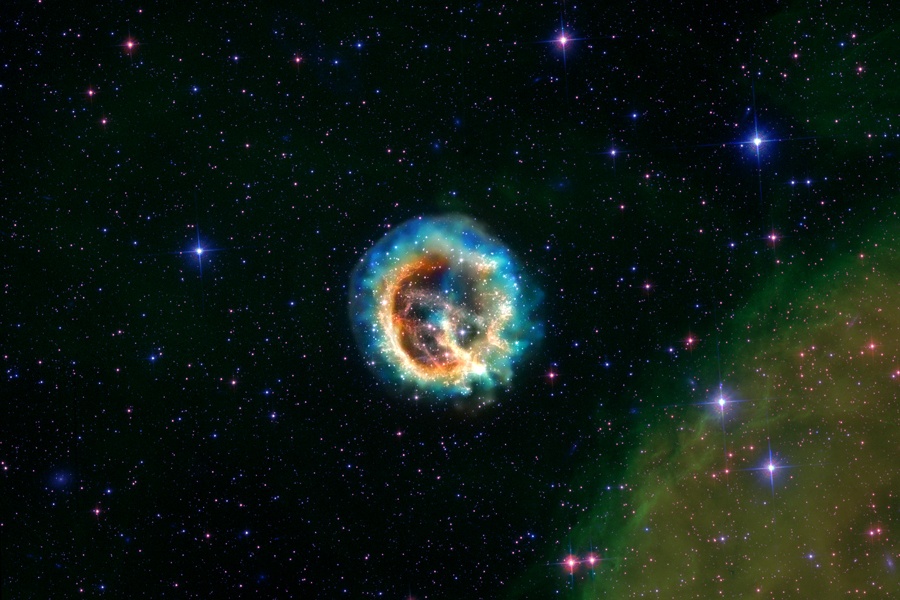
大質量星の爆発によって膨張する残骸雲は、チャンドラX線望遠鏡とハッブル宇宙望遠鏡のX線画像と光学画像を組み合わせたこの多波長合成画像に捉えられています。E0102-72と特定されたこの超新星残骸は、私たちの隣の銀河である小マゼラン雲に約19万光年離れたところにあります。強力な宇宙X線源であるE0102は、1999年の打ち上げ直後にチャンドラX線観測衛星によって撮影されました。チャンドラの10周年を記念して、追加のチャンドラデータを含むE0102とその周辺を描いたこのカラフルな画像が作成されました。すべてのデータの分析によると、E0102の全体的な形状は、球状の泡ではなく、正面から見た円筒形である可能性が最も高いことが示されています。この興味深い結果は、大質量星の爆発が、より質量の小さい星に関連する惑星状星雲に見られる形状に似ていることを示唆しています。小マゼラン雲までの距離では、この視野は約150光年に及ぶ。
原文(English)
The expanding debris cloud from the explosion of a massive star is captured in this multiwavelength composite, combining x-ray and optical images from the Chandra and Hubble telescopes. Identified as E0102-72, the supernova remnant lies about 190,000 light-years away in our neighboring galaxy, the Small Magellanic Cloud. A strong cosmic source of x-rays, E0102 was imaged by the Chandra X-ray Observatory shortly after its launch in 1999. In celebration of Chandra's 10th anniversary, this colorful view of E0102 and its environs was created, including additional Chandra data. An analysis of all the data indicates that the overall shape of E0102 is most likely a cylinder that is viewed end-on rather than a spherical bubble. The intriguing result implies that the massive star's explosion has produced a shape similar to what is seen in some planetary nebulae associated with lower mass stars. At the distance of the Small Magellanic Cloud, this field of view spans about 150 light-years.
\ この感動を宇宙仲間にシェア /
宇宙をXでシェア
© NASA / APOD