素晴らしい天文台で銀河中心を探検しよう
Great Observatories Explore Galactic Center
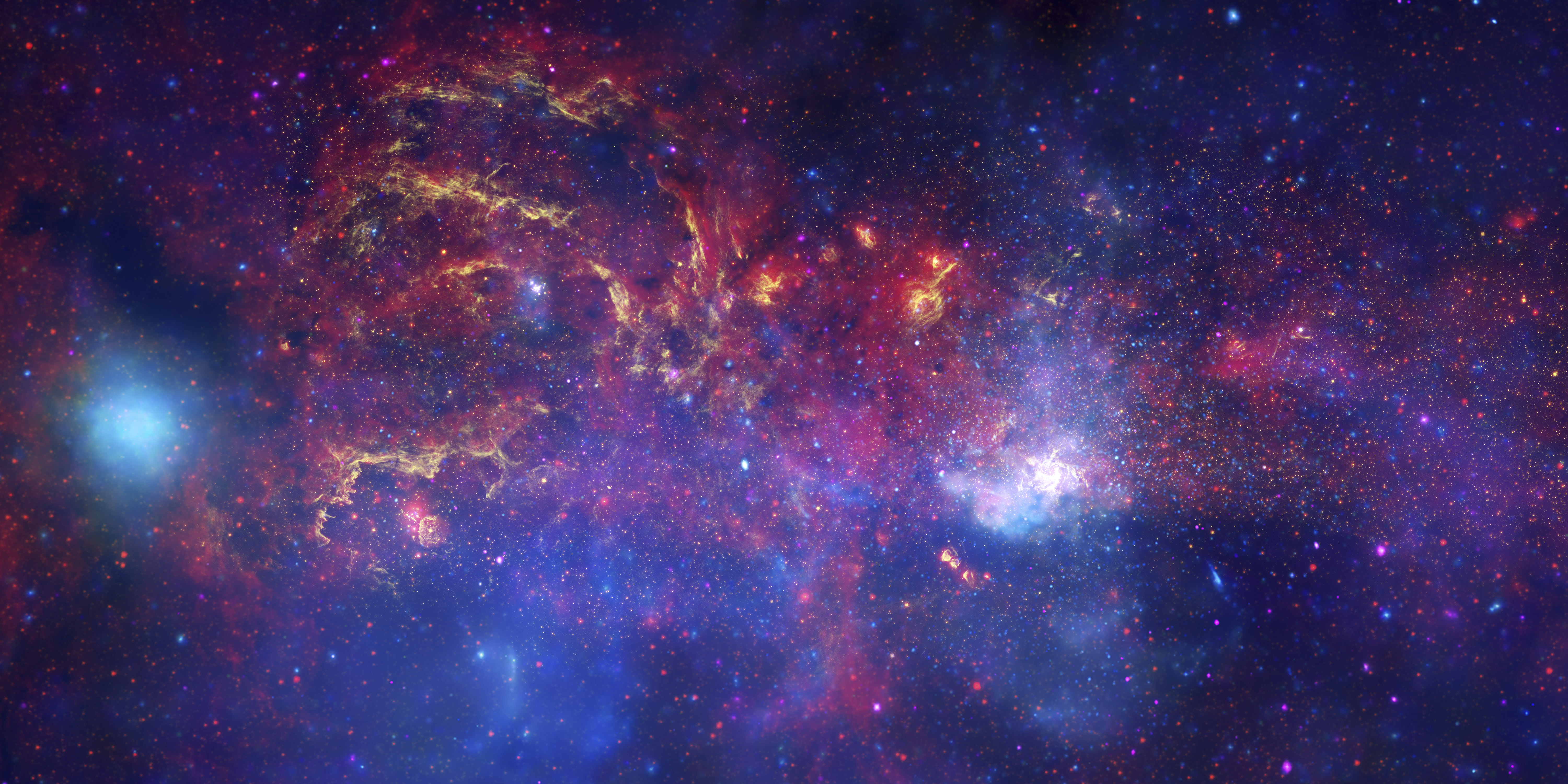
望遠鏡はどこへ連れて行ってくれるのでしょうか?400年前、望遠鏡はガリレオを月へ連れて行きクレーターを発見させ、土星へ連れて行き環を発見させ、木星へ連れて行き衛星を発見させ、金星へ連れて行き満ち欠けを発見させ、太陽へ連れて行き黒点を発見させました。今日、ガリレオの望遠鏡による功績を称え、国際天文学年の一環として、NASAは全天文台とインターネットを駆使して、銀河系の中心を皆さんにお届けします。上に掲載されているのは、ハッブル宇宙望遠鏡による近赤外線画像、スピッツァー宇宙望遠鏡による赤外線画像、チャンドラX線観測衛星によるX線画像を合成したもので、これまでにないほど詳細かつ鮮やかな色彩で映し出されています。広大な星野の数々、高密度の星団、ガスと塵の長いフィラメント、膨張する超新星残骸、そしておそらく銀河系の中心にあるブラックホールの周囲など、様々な星々が見ることができます。これらの特徴の多くは、補足的な注釈付き画像にラベル付けされています。もちろん、望遠鏡の倍率と集光能力によって得られるのは、人間がこれらの場所を訪れた際に目にするであろう光景のほんの一部に過ぎません。実際にそこへ行くにはロケットが必要です。
原文(English)
Where can a telescope take you? Four hundred years ago, a telescope took Galileo to the Moon to discover craters, to Saturn to discover rings, to Jupiter to discover moons, to Venus to discover phases, and to the Sun to discover spots. Today, in celebration of Galileo's telescopic achievements and as part of the International Year of Astronomy, NASA has used its entire fleet of Great Observatories, and the Internet, to bring the center of our Galaxy to you. Pictured above, in greater detail and in more colors than ever seen before, are the combined images of the Hubble Space Telescope in near-infrared light, the Spitzer Space Telescope in infrared light, and the Chandra X-ray Observatory in X-ray light. A menagerie of vast star fields is visible, along with dense star clusters, long filaments of gas and dust, expanding supernova remnants, and the energetic surroundings of what likely is our Galaxy's central black hole. Many of these features are labeled on a complementary annotated image. Of course, a telescope's magnification and light-gathering ability create only an image of what a human could see if visiting these places. To actually go requires rockets.
\ この感動を宇宙仲間にシェア /
宇宙をXでシェア
© NASA / APOD