パウリの排他原理:なぜ崩壊しないのか
Pauli Exclusion Principle: Why You Don't Implode
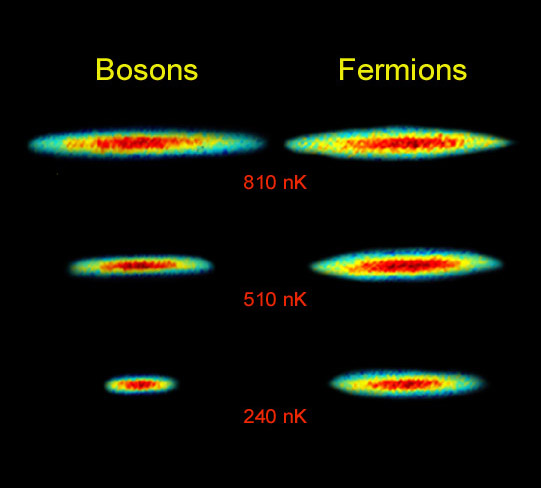
なぜ物質はただ集まってはいけないのでしょうか?中性子星や白色矮星が崩壊しないのと同じ原理が、人間が崩壊しない理由であり、通常の物質がほとんど空虚な空間である理由でもあります。観測された理由はパウリの排他原理として知られています。この原理は、同一のフェルミオン(基本的な物質の一種)は、同じ場所に同じ時間、同じ向きで存在できないと述べています。もう一方の種類の物質であるボソンにはこの性質はなく、最近生成されたボーズ・アインシュタイン凝縮体によって明確に示されています。今世紀初頭、パウリの排他原理は、リチウムの2つの同位体の雲の上の図で視覚的に示されました。左側の雲はボソンで構成され、右側の雲はフェルミオンで構成されています。温度が下がると、ボソンは集まりますが、フェルミオンは距離を保つ方が適しています。パウリの排他原理が正しい理由と、この原理の物理的な限界はまだ不明です。
原文(English)
Why doesn't matter just bunch up? The same principle that keeps neutron stars and white dwarf stars from imploding also keeps people from imploding and makes normal matter mostly empty space. The observed reason is known as the Pauli Exclusion Principle. The principle states that identical fermions -- one type of fundamental matter -- cannot be in the same place at the same time and with the same orientation. The other type of matter, bosons, do not have this property, as demonstrated clearly by recently created Bose-Einstein condensates. Earlier this decade, the Pauli Exclusion Principle was demonstrated graphically in the above picture of clouds of two isotopes of lithium -- the left cloud composed of bosons while the right cloud is composed of fermions. As temperature drops, the bosons bunch together, while the fermions better keep their distance. The reason why the Pauli Exclusion Principle is true and the physical limits of the principle are still unknown.
\ この感動を宇宙仲間にシェア /
宇宙をXでシェア
© Andrew Truscott &
Randall Hulet
(Rice U.) / APOD