心の彼方の銀河:マッフェイ1と2
Galaxies Beyond the Heart: Maffei 1 and 2
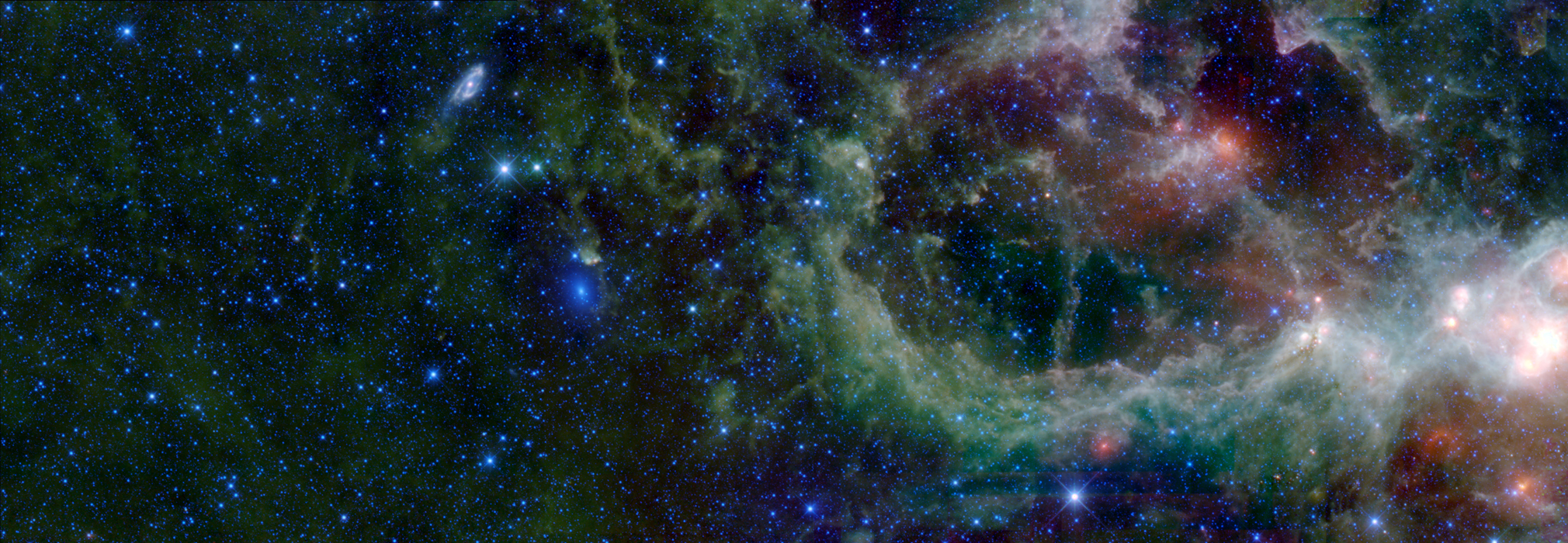
左端の2つの銀河は1968年まで知られていませんでした。夜空では明るい銀河の2つとして見えたはずですが、天の川銀河の中心帯の不透明な塵によって、可視光では見えませんでした。しかし、最近打ち上げられた広視野赤外線探査機(WISE)が赤外線で撮影した上の画像では、これらの銀河が、写真映えするハート星雲(IC 1805)のはるか後方、しかしすぐ隣にあるように見える場所に、非常に詳細に写っています。上部近くにある渦巻銀河は最も見つけやすく、マッフェイ2として知られています。そのすぐ下、右側には、地球に最も近い巨大楕円銀河である、ぼやけて見えるマッフェイ1があります。上の擬似カラー画像は、上から下まで満月3つ分に相当します。マッフェイ銀河はそれぞれ直径約1万5000光年で、カシオペヤ座の方向、地球から約1000万光年離れたところに位置しています。右側の画像では、星々、ガス状のフィラメント、そして温かい塵が、ハート星雲の詳細な赤外線画像を際立たせています。
原文(English)
The two galaxies on the far left were unknown until 1968. Although they would have appeared as two of the brighter galaxies on the night sky, the opaque dust of the central band of our Milky Way Galaxy had obscured them from being seen in visible light. The above image in infrared light taken by the recently launched Wide-Field Infrared Survey Explorer (WISE), however, finds these galaxies in great detail far behind -- but seemingly next to -- the photogenic Heart nebula (IC 1805). The spiral galaxy near the top is the easiest to spot and is known as Maffei 2. Just below and to its right is fuzzy-looking Maffei 1, the closest giant elliptical galaxy to Earth. The above false-colored image spans three full moons from top to bottom. The Maffei galaxies each span about 15,000 light years across and lie about 10 million light years away toward the constellation of the Queen of Ethiopia (Cassiopeia). On the image right, stars, gaseous filaments, and warm dust highlight a detailed infrared view of the Heart nebula.
\ この感動を宇宙仲間にシェア /
宇宙をXでシェア
© NASA / APOD