ハッブルのメシエ5
Hubble's Messier 5
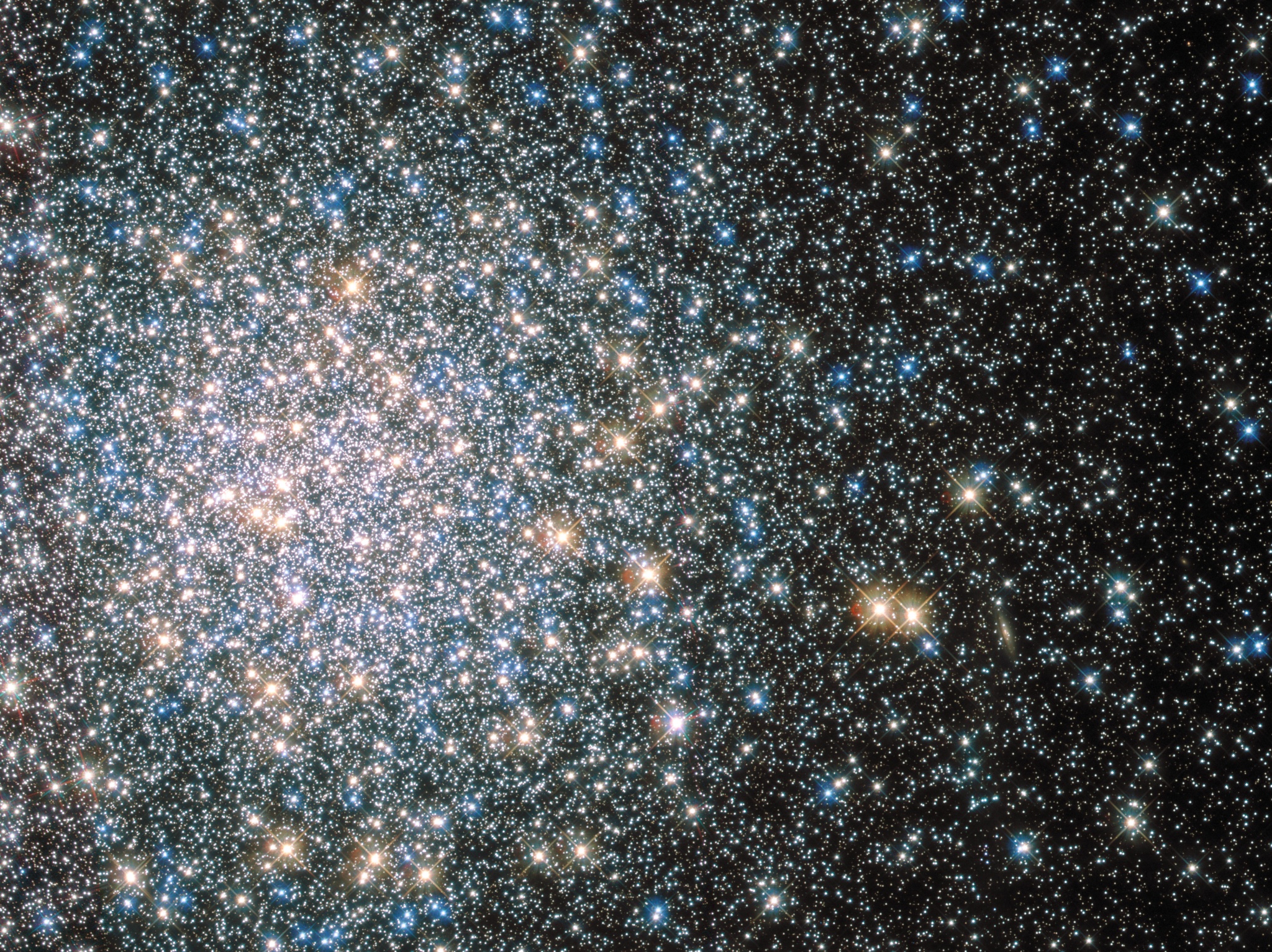
「天秤座と蛇座の間に美しい星雲が発見された…」これは、18世紀の天文学者シャルル・メシエの有名な星雲と星団のカタログの5番目の項目の説明の始まりです。メシエにはぼんやりと丸く、星がないように見えましたが、メシエ5(M5)は現在、重力によって束縛され、直径約165光年の領域に密集した10万個以上の星からなる球状星団であることがわかっています。地球から約2万5000光年離れたところにあります。銀河のハローをさまよう球状星団は、天の川の古代のメンバーです。M5は最も古い球状星団の1つで、その星は130億年近く前のものと推定されています。この美しい星団は、地上の望遠鏡で人気の観測対象です。もちろん、1990年4月25日に低軌道に投入されたハッブル宇宙望遠鏡も、M5銀河団の中心付近の約20光年にわたる見事な近接画像を捉えている。左側の密度の高い中心部付近でも、この銀河団の老齢の赤色巨星や青色巨星、そして若返った青色の星々が、鮮明なカラー画像の中で黄色や青色の色合いで際立っている。
原文(English)
"Beautiful Nebula discovered between the Balance [Libra] & the Serpent [Serpens] ..." begins the description of the 5th entry in 18th century astronomer Charles Messier's famous catalog of nebulae and star clusters. Though it appeared to Messier to be fuzzy and round and without stars, Messier 5 (M5) is now known to be a globular star cluster, 100,000 stars or more, bound by gravity and packed into a region around 165 light-years in diameter. It lies some 25,000 light-years away. Roaming the halo of our galaxy, globular star clusters are ancient members of the Milky Way. M5 is one of the oldest globulars, its stars estimated to be nearly 13 billion years old. The beautiful star cluster is a popular target for Earthbound telescopes. Of course, deployed in low Earth orbit on April 25, 1990, the Hubble Space Telescope has also captured its own stunning close-up view that spans about 20 light-years near the central region of M5. Even close to its dense core at the left, the cluster's aging red and blue giant stars and rejuvenated blue stragglers stand out in yellow and blue hues in the sharp color image.
\ この感動を宇宙仲間にシェア /
宇宙をXでシェア
© NASA / APOD