重力の微笑み
Gravity's Grin
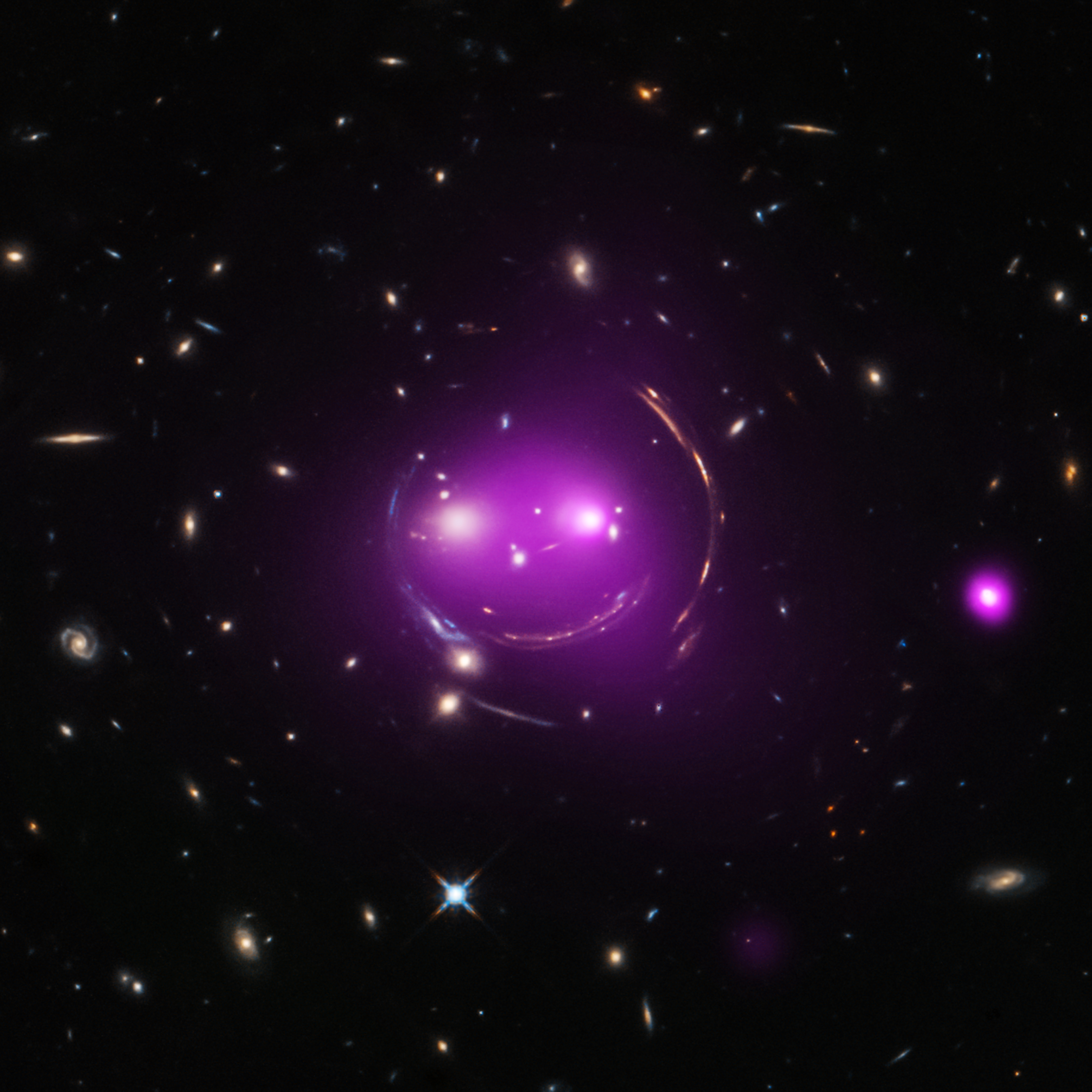
100年以上前に発表されたアルバート・アインシュタインの一般相対性理論は、重力レンズ現象を予言していました。そして、チャンドラX線望遠鏡とハッブル宇宙望遠鏡のX線および光学画像データを通して見ると、これらの遠方の銀河が奇妙な外観を呈するのはそのためです。チェシャ猫銀河群という愛称で呼ばれるこの銀河群の2つの大きな楕円銀河は、弧によって示唆的に縁取られています。これらの弧は、前景にある銀河群の重力質量の総分布によってレンズ効果を受けた遠方の背景銀河の光学像です。もちろん、その重力質量の大部分はダークマターです。2つの大きな楕円形の「目」銀河は、合体しているそれぞれの銀河群の中で最も明るいメンバーです。それらの相対的な衝突速度は毎秒約1,350キロメートルで、ガスを数百万度まで加熱し、紫色で示されるX線の光を生み出しています。銀河群の合体についてもっと知りたいですか?チェシャ猫銀河群は、おおぐま座に位置し、地球から約46億光年離れた場所でニヤリと笑っています。
原文(English)
Albert Einstein's general theory of relativity, published over 100 years ago, predicted the phenomenon of gravitational lensing. And that's what gives these distant galaxies such a whimsical appearance, seen through the looking glass of X-ray and optical image data from the Chandra and Hubble space telescopes. Nicknamed the Cheshire Cat galaxy group, the group's two large elliptical galaxies are suggestively framed by arcs. The arcs are optical images of distant background galaxies lensed by the foreground group's total distribution of gravitational mass. Of course, that gravitational mass is dominated by dark matter. The two large elliptical "eye" galaxies represent the brightest members of their own galaxy groups which are merging. Their relative collisional speed of nearly 1,350 kilometers/second heats gas to millions of degrees producing the X-ray glow shown in purple hues. Curiouser about galaxy group mergers? The Cheshire Cat group grins in the constellation Ursa Major, some 4.6 billion light-years away.
\ この感動を宇宙仲間にシェア /
宇宙をXでシェア
© NASA / APOD