オールスカイ・スティーブ
All-Sky Steve
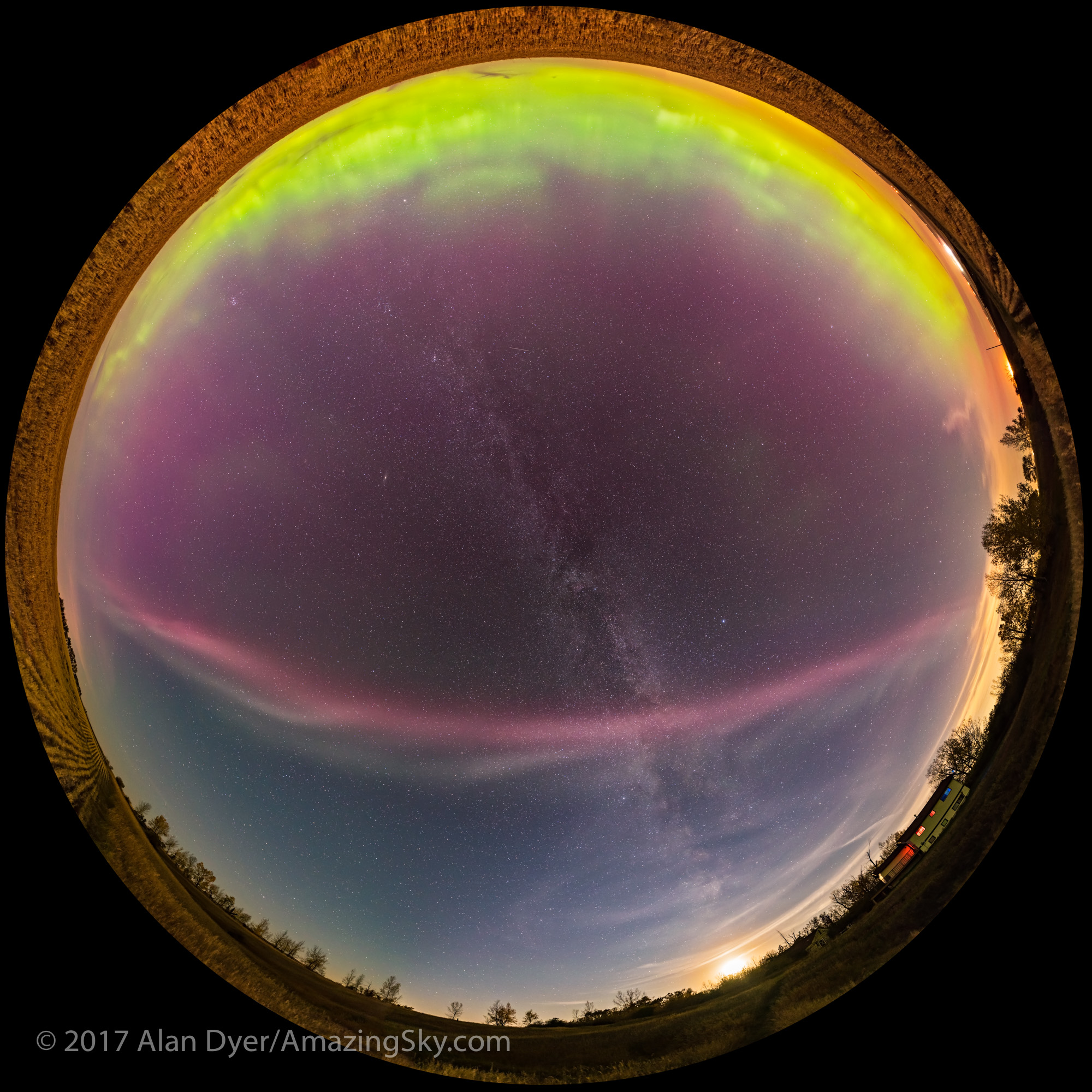
9月27日の魚眼パノラマ投影では、おなじみの緑と赤みを帯びたオーロラの発光が北(上)の地平線に沿って空を覆っています。穏やかで晴れた夕方、天の川はアルバータ州南部の空の天頂を横切り、6日前の月が南西に沈むところで終わります。南に広がる奇妙で孤立したピンクと白っぽい弧は、スティーブとして知られるようになりました。この名前は、オーロラのような特徴の出現を記録したアルバータ・オーロラ・チェイサーズのFacebookグループによってこの現象に付けられました。陽子オーロラまたは陽子アークと誤って識別されることもある謎のスティーブアークは、オーロラに関連しているようですが、オーロラカーテンよりも赤道に近いところに現れます。市民科学者によって広く記録され、最近ではSwarmミッション衛星によって直接調査されたスティーブアークは、高エネルギー電子によって励起された発光ではなく、流れるガスからの熱放射として測定されています。元々の親しみやすい名前に合うように逆算して作られた頭字語は「速度増強による突然の熱放出」だが、その起源は依然として謎に包まれている。
原文(English)
Familiar green and red tinted auroral emission floods the sky along the northern (top) horizon in this fish-eye panorama projection from September 27. On the mild, clear evening the Milky Way tracks through the zenith of a southern Alberta sky and ends where the six-day-old Moon sets in the southwest. The odd, isolated, pink and whitish arc across the south has come to be known as Steve. The name was given to the phenomenon by the Alberta Aurora Chasers Facebook group who had recorded appearances of the aurora-like feature. Sometimes mistakenly identified as a proton aurora or proton arc, the mysterious Steve arcs seem associated with aurorae but appear closer to the equator than the auroral curtains. Widely documented by citizen scientists and recently directly explored by a Swarm mission satellite, Steve arcs have been measured as thermal emission from flowing gas rather than emission excited by energetic electrons. Even though a reverse-engineered acronym that fits the originally friendly name is Sudden Thermal Emission from Velocity Enhancement, his origin is still mysterious.
\ この感動を宇宙仲間にシェア /
宇宙をXでシェア
© Alan Dyer / APOD