渦巻銀河D100の長いガス尾
The Long Gas Tail of Spiral Galaxy D100
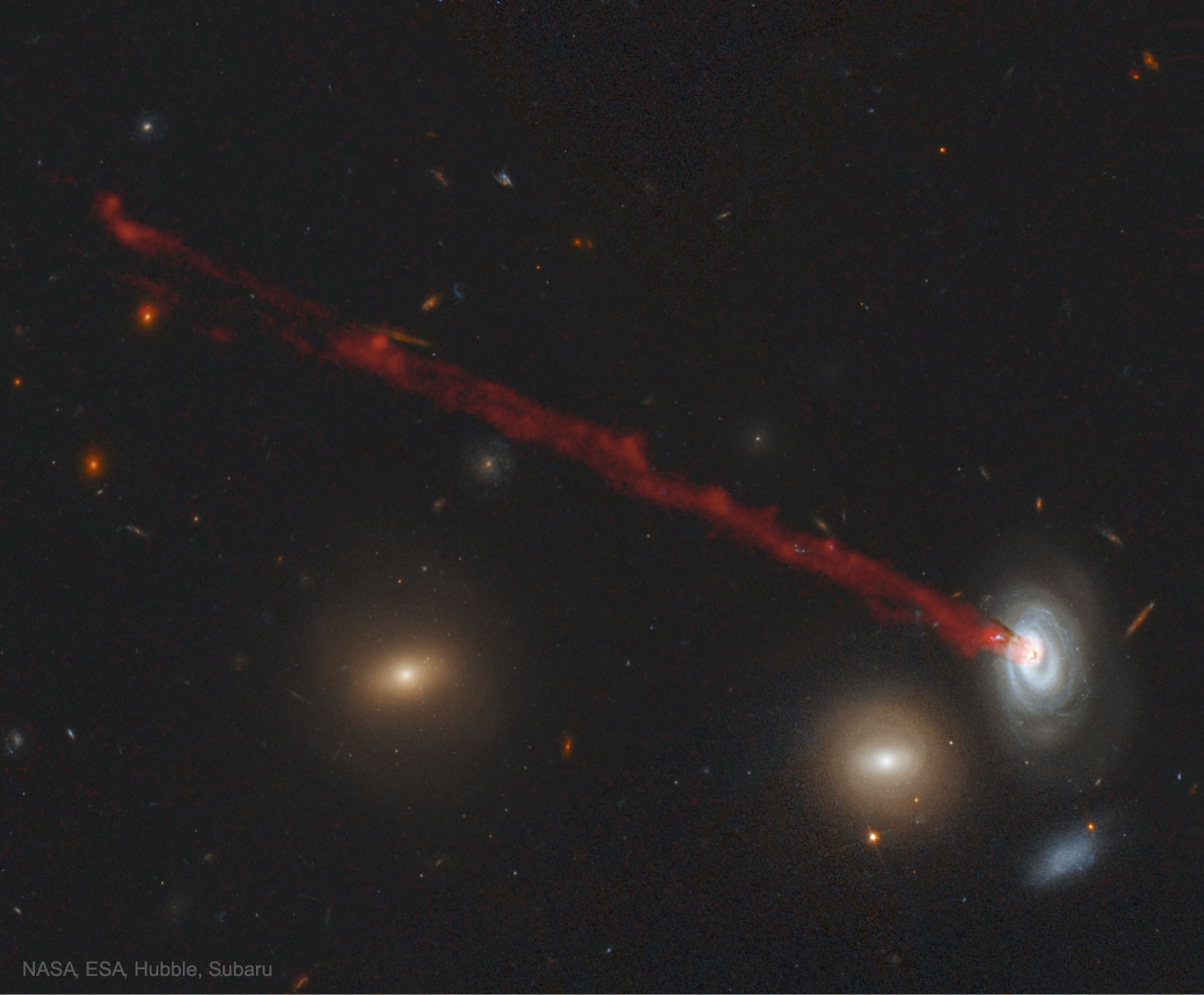
なぜこの銀河には長い赤い筋がついているのでしょうか?この筋は主に輝く水素でできており、銀河が銀河団内の高温ガスの中を移動する際に、系統的に剥ぎ取られたものです。具体的には、この銀河は渦巻銀河D100で、銀河団はかみのけ座銀河団です。赤い筋がD100の中心に繋がっているのは、重力が弱い外側のガスがすでにラム圧によって剥ぎ取られているためです。この伸びたガスの尾は約20万光年の長さがあり、太陽の約40万倍の質量を持ち、その中で星が形成されています。D100の左下に見える銀河D99は、主に古い赤い星の光で輝いているため赤く見えます。D99は星形成ガスを剥ぎ取られてしまったため、若い青い星はもはや形成されません。掲載されている擬似カラー画像は、地球周回軌道上のハッブル宇宙望遠鏡と地上望遠鏡であるすばる望遠鏡の画像をデジタル処理で合成したものです。このような注目すべき天体群を研究することで、銀河団における銀河の進化の仕組みについての理解が深まります。
原文(English)
Why is there long red streak attached to this galaxy? The streak is made mostly of glowing hydrogen that has been systematically stripped away as the galaxy moved through the ambient hot gas in a cluster of galaxies. Specifically, the galaxy is spiral galaxy D100, and cluster is the Coma Cluster of galaxies. The red path connects to the center of D100 because the outer gas, gravitationally held less strongly, has already been stripped away by ram pressure. The extended gas tail is about 200,000 light-years long, contains about 400,000 times the mass of our Sun, and stars are forming within it. Galaxy D99, visible to D100's lower left, appears red because it glows primarily from the light of old red stars -- young blue stars can no longer form because D99 has been stripped of its star-forming gas. The featured false-color picture is a digitally enhanced composite of images from Earth-orbiting Hubble and the ground-based Subaru telescope. Studying remarkable systems like this bolsters our understanding of how galaxies evolve in clusters.
\ この感動を宇宙仲間にシェア /
宇宙をXでシェア
© NASA,
ESA,
Hubble,
Subaru Telescope,
W. Cramer
(Yale)
et al.,
M. Yagi,
J. DePasquale / APOD