シュテファンの五重奏曲
Stephan's Quintet
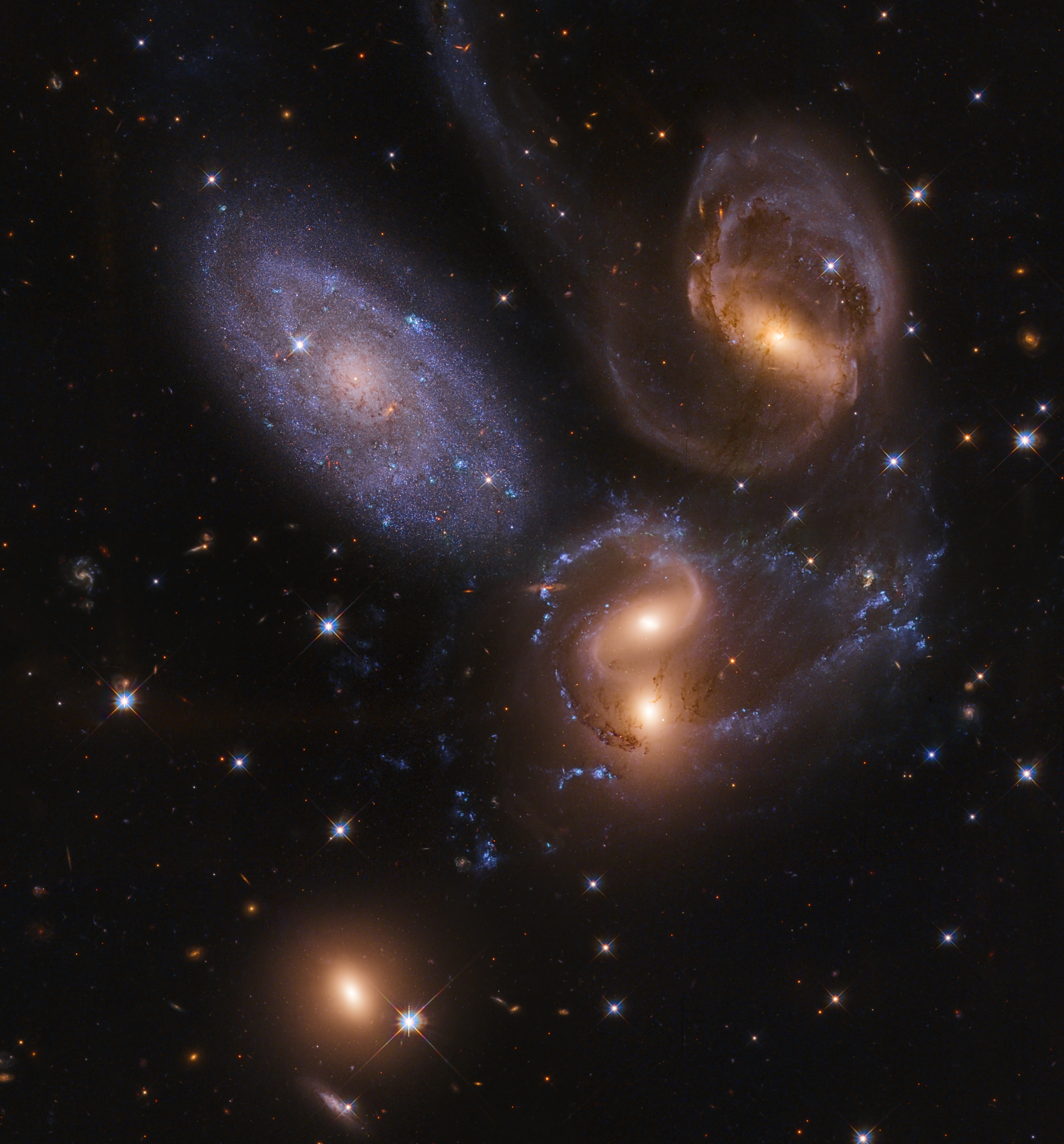
最初に特定されたコンパクト銀河群であるステファンの五重銀河は、ハッブル・レガシー・アーカイブの膨大なデータから作成されたこの目を引く画像に写っています。約3億光年離れたところにあるこれらの5つの銀河のうち、実際に宇宙的なダンスを繰り広げているのは4つだけです。しかし、異質な銀河は簡単に見つけることができます。相互作用している銀河NGC 7319、7318A、7318B、および7317は、全体的に黄色みを帯びています。また、破壊的な重力潮汐の影響を受けて成長した、歪んだループと尾を持つ傾向があります。しかし、主に青みがかった銀河NGC 7320は、わずか4000万光年しか離れておらず、相互作用している銀河群には含まれていません。ステファンの五重銀河は、高く舞うペガスス座の境界内に位置しています。相互作用する4つの銀河の推定距離に基づくと、この視野は約50万光年に及ぶ。しかし、この視野のすぐ上、右上方向に目を移すと、天文学者たちは別の銀河NGC 7320Cを特定できる。この銀河も3億光年離れている。これを含めると、相互作用する4つの銀河は再び5つの銀河となる。
原文(English)
The first identified compact galaxy group, Stephan's Quintet is featured in this eye-catching image constructed with data drawn from the extensive Hubble Legacy Archive. About 300 million light-years away, only four of these five galaxies are actually locked in a cosmic dance of repeated close encounters. The odd man out is easy to spot, though. The interacting galaxies, NGC 7319, 7318A, 7318B, and 7317 have an overall yellowish cast. They also tend to have distorted loops and tails, grown under the influence of disruptive gravitational tides. But the predominantly bluish galaxy, NGC 7320, is closer, just 40 million light-years distant, and isn't part of the interacting group. Stephan's Quintet lies within the boundaries of the high flying constellation Pegasus. At the estimated distance of the quartet of interacting galaxies, this field of view spans about 500,000 light-years. But moving just beyond this field, up and to the right, astronomers can identify another galaxy, NGC 7320C, that is also 300 million light-years distant. Including it would bring the interacting quartet back up to quintet status.
\ この感動を宇宙仲間にシェア /
宇宙をXでシェア
© NASA / APOD