NGC 1316:銀河衝突後
NGC 1316: After Galaxies Collide
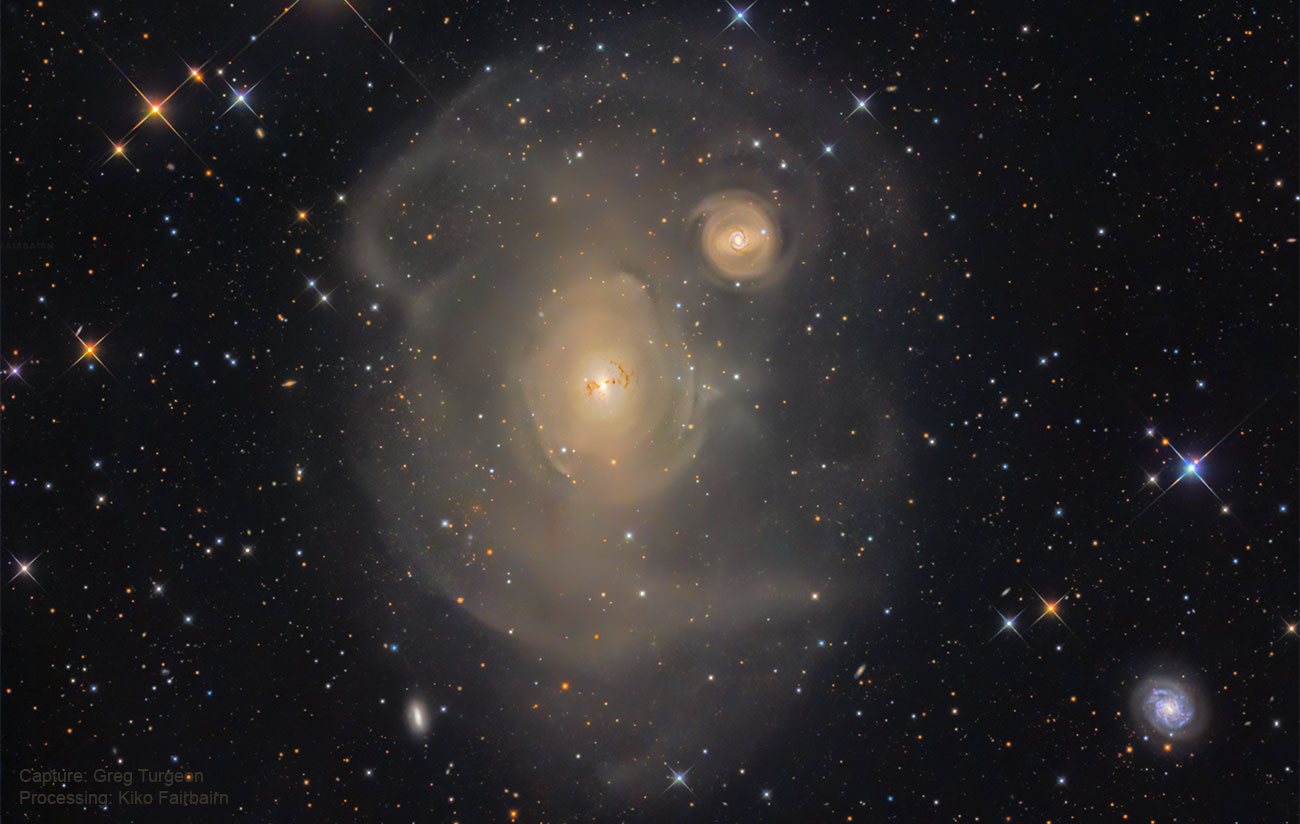
天文学者たちは、NGC 1316のような驚くべき現象の原因を解明しようと、探偵のように調査を進めます。調査によると、NGC 1316は巨大な楕円銀河で、約1億年前に右上にあるより小さな渦巻銀河NGC 1317を飲み込み始めたことが示唆されています。この広大で深遠な画像には、渦巻銀河に特徴的な暗い塵の帯や、星とガスのかすかな渦巻きや殻が見られるなど、それを裏付ける証拠があります。未だに解明されていないのは、画像上でかすかな点として見える、異常に小さな球状星団です。ほとんどの楕円銀河は、NGC 1316よりも多くの、そしてより明るい球状星団を持っています。しかし、観測された球状星団は、最近の渦巻き衝突によって形成されたにしては古すぎます。一つの仮説は、これらの球状星団はNGC 1316に吸収されたさらに古い銀河の名残であるというものだ。また、フォルナックスAとしても知られるNGC 1316のもう一つの驚くべき特徴は、電波で明るく輝く巨大なガスローブである。
原文(English)
Astronomers turn detectives when trying to figure out the cause of startling sights like NGC 1316. Investigations indicate that NGC 1316 is an enormous elliptical galaxy that started, about 100 million years ago, to devour a smaller spiral galaxy neighbor, NGC 1317, just on the upper right. Supporting evidence includes the dark dust lanes characteristic of a spiral galaxy, and faint swirls and shells of stars and gas visible in this wide and deep image. One thing that >remains unexplained is the unusually small globular star clusters, seen as faint dots on the image. Most elliptical galaxies have more and brighter globular clusters than NGC 1316. Yet the observed globulars are too old to have been created by the recent spiral collision. One hypothesis is that these globulars survive from an even earlier galaxy that was subsumed into NGC 1316. Another surprising attribute of NGC 1316, also known as Fornax A, is its giant lobes of gas that glow brightly in radio waves.
\ この感動を宇宙仲間にシェア /
宇宙をXでシェア
© Capture:
Greg Turgeon;
Processing:
Kiko Fairbairn / APOD