猫の目星雲の中心にて
In the Center of the Cat's Eye Nebula
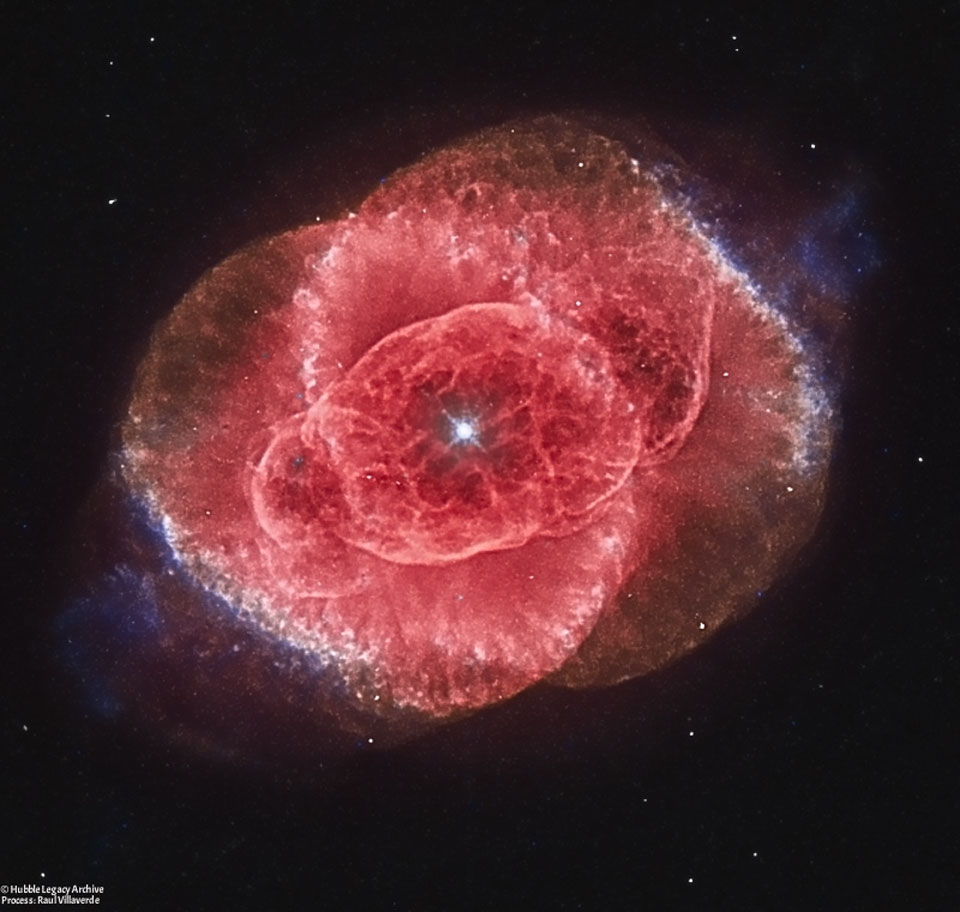
3000光年離れた場所で、死にゆく星が輝くガスの殻を放出している。ハッブル宇宙望遠鏡が撮影したこの画像は、キャッツアイ星雲(NGC 6543)が、既知の惑星状星雲の中で最も複雑なものの1つであることを示している。半光年にわたって広がるキャッツアイの特徴は非常に複雑であるため、天文学者は明るい中心天体が実際には連星系である可能性を疑っている。この種の天体を表すのに使われる「惑星状星雲」という用語は誤解を招く。これらの天体は小型望遠鏡では丸く惑星のように見えるかもしれないが、大型望遠鏡による高解像度画像では、恒星進化の後期段階で吹き飛ばされたガスの繭に囲まれた星であることが明らかになる。このキャッツアイを見つめる天文学者は、詳細な構造以上のものを見ているのかもしれない。彼らは、約50億年後に惑星状星雲の進化段階に入る運命にある私たちの太陽の運命を見ているのかもしれない。
原文(English)
Three thousand light-years away, a dying star throws off shells of glowing gas. This image from the Hubble Space Telescope reveals the Cat's Eye Nebula (NGC 6543), to be one of the most complex planetary nebulae known. Spanning half a light-year, the features seen in the Cat's Eye are so complex that astronomers suspect the bright central object may actually be a binary star system. The term planetary nebula, used to describe this general class of objects, is misleading. Although these objects may appear round and planet-like in small telescopes, high resolution images with large telescopes reveal them to be stars surrounded by cocoons of gas blown off in the late stages of stellar evolution. Gazing into this Cat's Eye, astronomers may well be seeing more than detailed structure, they may be seeing the fate of our Sun, destined to enter its own planetary nebula phase of evolution ... in about 5 billion years.
\ この感動を宇宙仲間にシェア /
宇宙をXでシェア
© Raul Villaverde / APOD