チューリップとシグナスX-1
The Tulip and Cygnus X-1
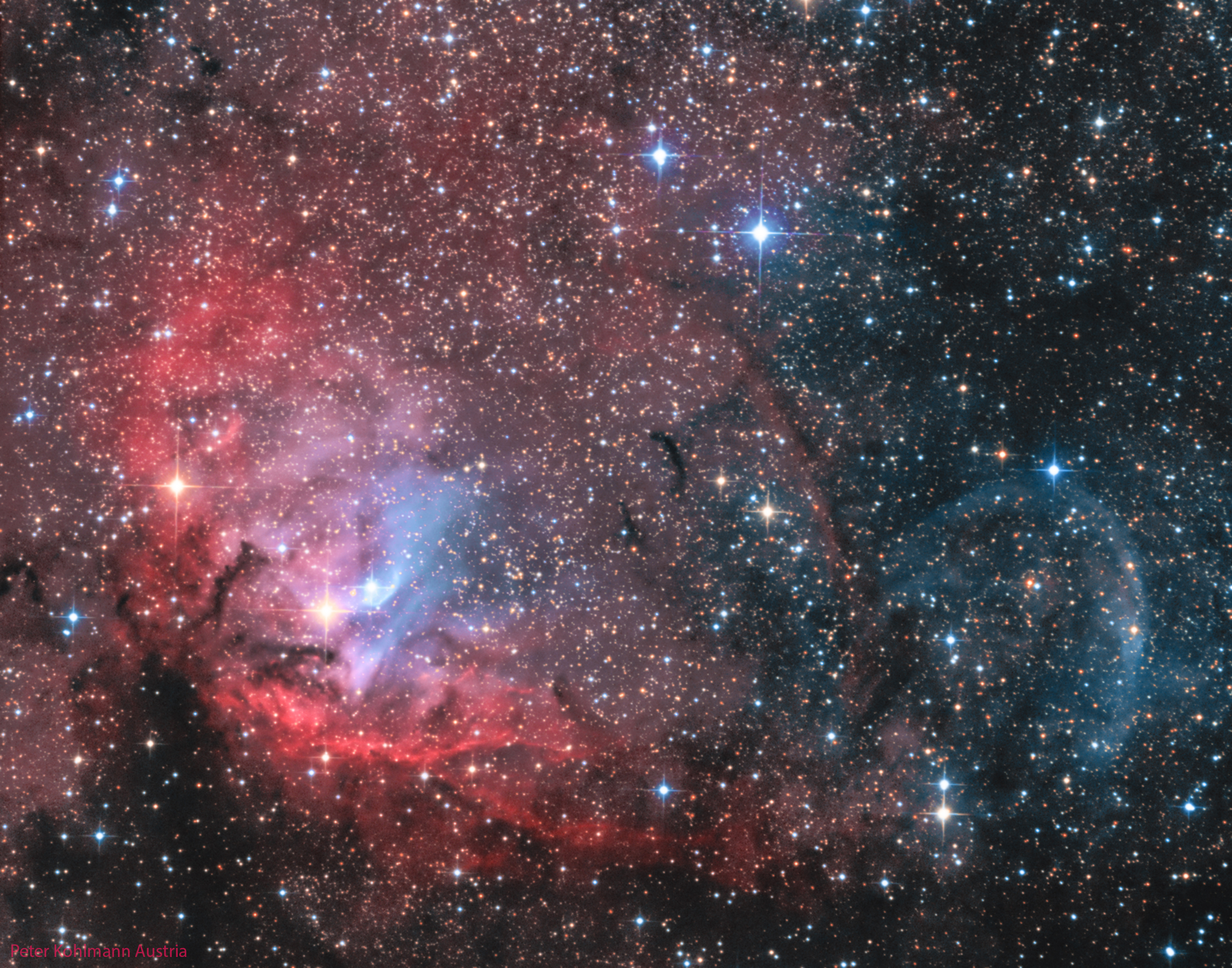
明るい放射領域を囲むように、この望遠鏡の眺めは、天の川銀河の平面に沿って星雲が豊富な星座である白鳥座を捉えています。一般にチューリップ星雲と呼ばれるこの赤く輝く星間ガスと塵の雲は、天文学者スチュワート・シャープレスによる1959年のカタログではSh2-101として記載されています。直径約70光年の複雑で美しいチューリップ星雲は、約8,000光年離れた場所に咲いています。O型星HDE 227018を含む白鳥座OB3アソシエーションの端にある若い高エネルギー星からの紫外線放射が原子を電離し、チューリップ星雲からの放射を駆動しています。視野内には、地球の空で最も強力なX線源の1つであるマイクロクエーサーCygnus X-1も含まれています。潜んでいるブラックホールから噴出する強力なジェットによって吹き飛ばされた、かすかな青みがかった湾曲した衝撃波面は、フレーム右側近くの宇宙のチューリップの花びらの向こうにかろうじて見える程度だ。新学期?NASAで科学を学ぼう
原文(English)
Framing a bright emission region, this telescopic view looks out along the plane of our Milky Way Galaxy toward the nebula rich constellation Cygnus the Swan. Popularly called the Tulip Nebula, the reddish glowing cloud of interstellar gas and dust is also found in the 1959 catalog by astronomer Stewart Sharpless as Sh2-101. Nearly 70 light-years across, the complex and beautiful Tulip Nebula blossoms about 8,000 light-years away. Ultraviolet radiation from young energetic stars at the edge of the Cygnus OB3 association, including O star HDE 227018, ionizes the atoms and powers the emission from the Tulip Nebula. Also in the field of view is microquasar Cygnus X-1, one of the strongest X-ray sources in planet Earth's sky. Blasted by powerful jets from a lurking black hole its fainter bluish curved shock front is only just visible though, beyond the cosmic Tulip's petals near the right side of the frame. Back to School? Learn Science with NASA
\ この感動を宇宙仲間にシェア /
宇宙をXでシェア
© Peter Kohlmann / APOD