ジュリアス・シーザーと閏日
Julius Caesar and Leap Days
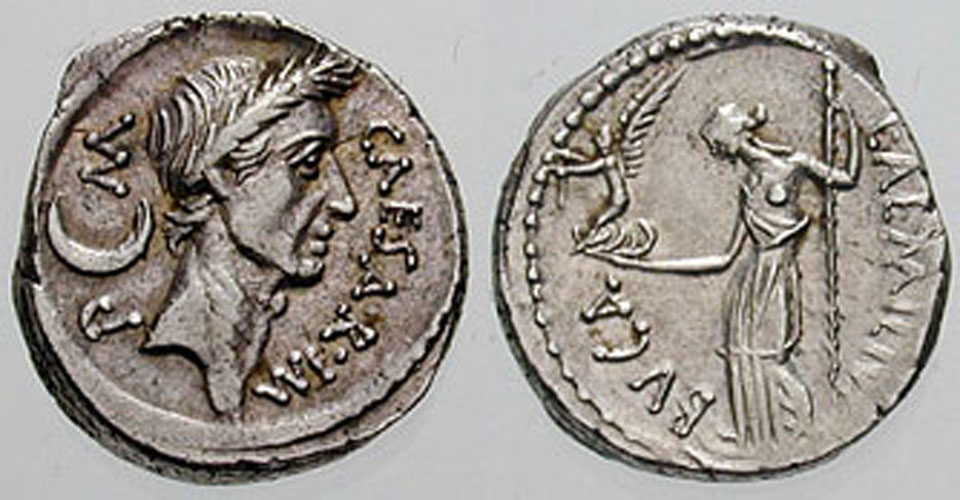
紀元前46年、ユリウス・カエサルは暦法を改革しました。アレクサンドリアの天文学者ソシゲネスの助言に基づき、ユリウス暦では地球の1年が365日よりわずかに長いことを考慮して、4年に1回閏日が設けられました。現代の基準で言えば、地球が太陽の周りを1周するのにかかる時間は平均太陽日で365.24219日です。そのため、暦年がちょうど365日であれば、地球の1年と4年に1日ずつずれていき、最終的には7月(ユリウス・カエサル自身にちなんで名付けられた)が北半球の冬に重なってしまうことになります。4年に1回閏日を設けることで、ユリウス暦のずれは大幅に軽減されました。1582年、グレゴリウス13世は、閏日は400で割り切れる場合を除き、末尾が00の年には設けてはならないという微調整を加えました。このグレゴリオ暦が今日広く用いられている暦法です。もちろん、地球と月の系における潮汐摩擦によって地球の自転速度は遅くなり、1世紀あたり約1.4ミリ秒ずつ徐々に1日の長さが長くなります。つまり、今から約400万年後には、今日のような閏日は不要になるということです。このローマの銀貨、デナリウスには、ユリウス・カエサル(左)とローマ神話の愛の女神ヴィーナスが描かれています。
原文(English)
In 46 BC Julius Caesar reformed the calendar system. Based on advice by astronomer Sosigenes of Alexandria, the Julian calendar included one leap day every four years to account for the fact that an Earth year is slightly more than 365 days long. In modern terms, the time it takes for the planet to orbit the Sun once is 365.24219 mean solar days. So if calendar years contained exactly 365 days they would drift from the Earth's year by about 1 day every 4 years and eventually July (named for Julius Caesar himself) would occur during the northern hemisphere winter. By adopting a leap year with an extra day every four years, the Julian calendar year would drift much less. In 1582 Pope Gregory XIII provided the further fine-tuning that leap days should not occur in years ending in 00, unless divisible by 400. This Gregorian Calendar system is the one in wide use today. Of course, tidal friction in the Earth-Moon system slows Earth's rotation and gradually lengthens the day by about 1.4 milliseconds per century. That means that leap days like today will not be necessary, about 4 million years from now. This Roman silver coin, a denarius, depicts Julius Caesar (left) and Venus, Roman goddess of love.
\ この感動を宇宙仲間にシェア /
宇宙をXでシェア
© NASA / APOD